
LinkedIn Games Edition
What eight game launches, zero funerals, and one missing reaction button reveal about LinkedIn's roadmap

When LinkedIn first announced games, I thought it was lunacy. Who is logging into LinkedIn, of all places, to play a game every day?
Turns out: me. I’m the person.
And as someone who spends her days thinking about product strategy, I’ve come to see LinkedIn Games as a genuinely interesting case study in feature rollout and engagement design.
A quick history, because the rollout itself is the story
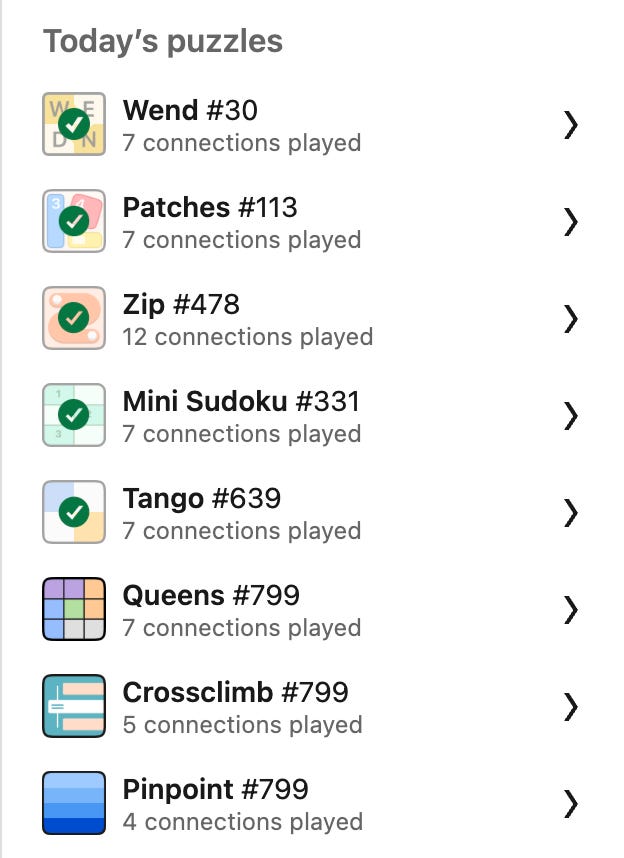
LinkedIn didn’t launch games with one big swing. It crept in:
May 2024: Three games launch — Queens, Pinpoint, and Crossclimb.
October 2024: Tango arrives, and logic puzzles (Queens, Tango) quickly emerge as the fan favorites.
December 2024: A “Playback” year-end recap of your game performance — including, memorably, how many CEOs you outscored.
March 2025: Zip joins as the designated “warm-up” game.
July 2025: Connection leaderboards go live, ranking you against your own network, updated daily.
August 2025: Mini Sudoku — and this one signals real investment. LinkedIn built it with Nikoli, the Japanese publisher that popularized Sudoku, and Thomas Snyder, a three-time World Sudoku Champion. “We’re not games for games’ sake,” their games product lead told CNBC at launch. Noted.
March 2026: Patches, a shape-fitting grid puzzle.
June 2026: Wend, the newest word puzzle — today was #30, so it’s about a month old.
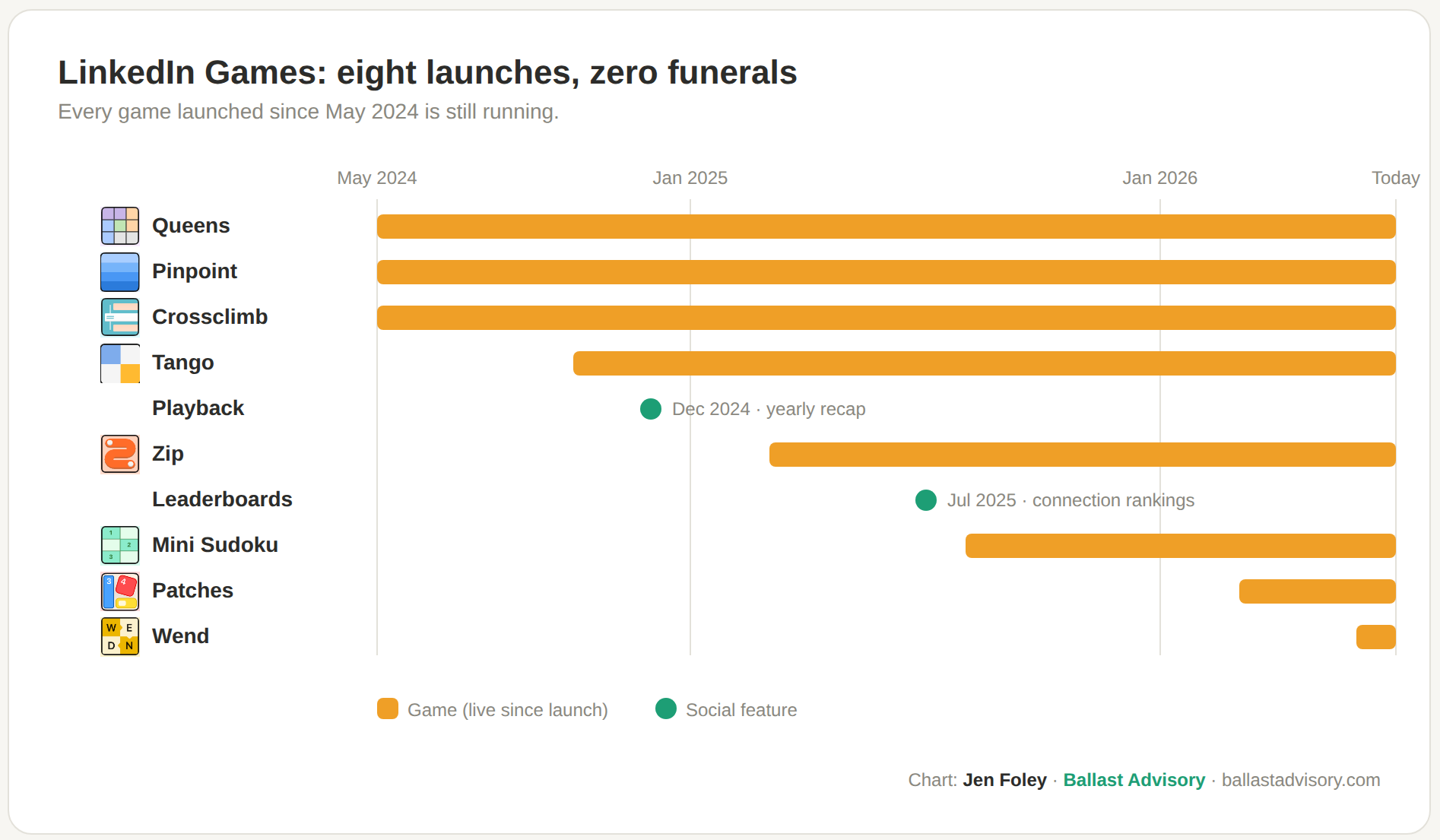
That’s eight launches in about two years — and the cadence is accelerating. Three games in year one; then Mini Sudoku, Patches, and Wend all arrived within ten months of each other. Notice the other pattern in that chart: every bar runs to today. Eight launches, zero funerals — so far. Each launch is small enough to feel like a treat rather than a pivot, and each one adds a new layer of social mechanics on top of the last.
The retention numbers explain why LinkedIn keeps pouring in: 84% of players return the next day, and 80% are still playing a week later. Games now drive over 2 million daily plays, and analysts credit them as one of the reasons LinkedIn’s daily-to-monthly active user ratio jumped from 0.38 to 0.42 this year. For a platform that historically struggled to give people a reason to show up daily versus when they’re job hunting.
The playbook is “borrowed”
Newspapers figured out a hundred years ago that a crossword turns readers from passive to active. The New York Times paid seven figures for Wordle in 2022 precisely because it came with a daily habit attached — and it worked spectacularly. NYT puzzles were played 11.2 billion times in 2025. Tens of millions of people play NYT Games every day, over half of weekly users play more than one puzzle daily, and Wordle alone averages north of 4 million daily players. The Times is literally turning Wordle into an NBC game show.
NYT knows you play. LinkedIn knows you play, and where you went to school, and who you work with.
The details I keep noticing
You can tag and follow the games themselves. A small decision with a big implication — each game is treated less like a feature and more like its own mini-product with its own audience.
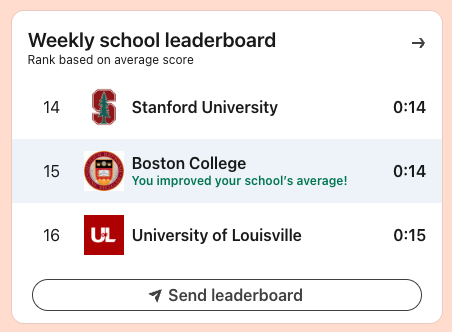
School leaderboards exist, and I can’t decide what they’re for.
Is this genuine competition or just a data point? I genuinely don’t know. What I do know is that Boston College is one spot behind UVA this week, separated by nothing, and some ancient part of my brain now cares about that. Also: “You improved your school’s average!” is a diabolically good line. I did something for BC today, apparently. Ever to Excel.
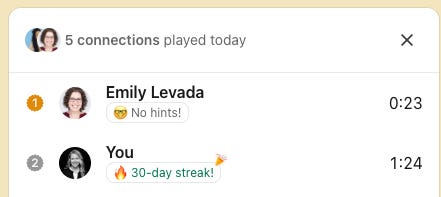
Connections opt in to share scores and times — and I like the opt-in. It’s low-stakes, it’s consensual, and it turns a solitary puzzle into a shared moment.
I am continually astounded by my connection Emily’s times. Twenty-three seconds. No hints. Whatever she’s eating for breakfast needs to go on my grocery list.
They show how many connections have played each game. Which means you can also see, in plain daylight, which games are popular and which aren’t. Poor Pinpoint.
What I’d change
It starts with a small wish: let me react to a connection’s score. A thumbs up, a fire emoji, anything. Right now, if Emily solves a puzzle in 23 seconds with no hints, there is no lightweight way for me to acknowledge that. I’d have to message her like some kind of stalker.
This is the strangest gap in the whole product. LinkedIn’s entire thesis for games is that they “spark conversations” and strengthen professional relationships — their games PM has said as much. They made scores visible enough to admire but not social enough to engage with. The engagement-loop company forgot the engagement loop’s last step.
But the more I sat with that wish, the more I realized the reaction button isn’t really the problem. It’s a symptom. The problem is the score reveal page itself — the moment after you finish a puzzle, which is the emotional peak of the whole experience and should be where the social loop closes. So I did what any product person with an opinion and an evening does: I redesigned it.
The desktop reveal, rearranged
Today, the post-game page is a single vertical stack — result card, connections leaderboard, school leaderboard, streak stats, game cross-sell, daily post — one after another, whether you’re on a phone or a 27-inch monitor. On desktop, that’s a phone screen with margins.
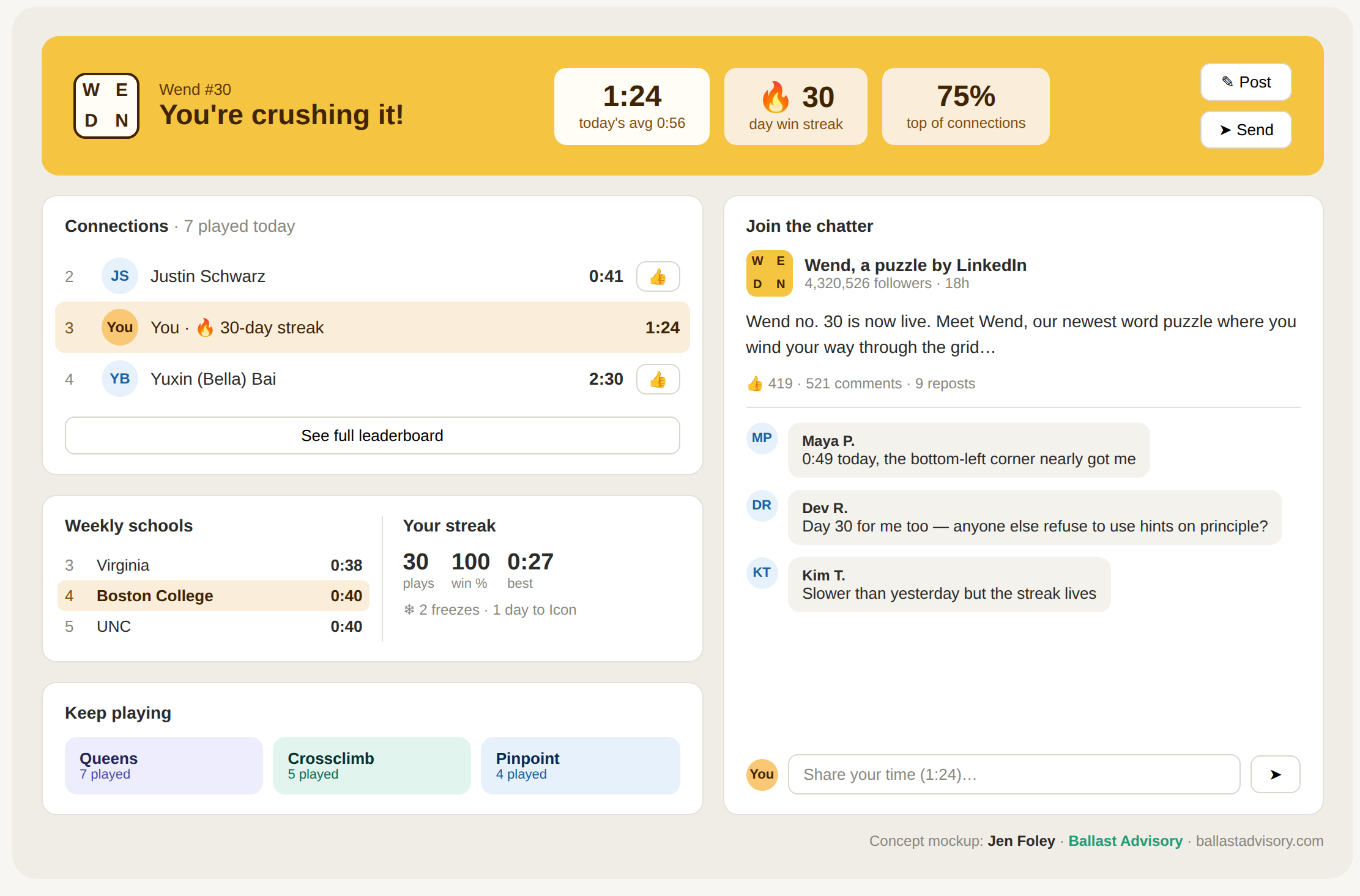
The rearrangement makes three arguments:
Kill the carousel. The result card currently hides two of your three stats (streak, percentile) behind swipe arrows. Carousels are a mobile compromise; on desktop, all three stats fit side by side in the hero, and Post/Send moves up there too — sharing should happen at the moment of peak feeling, not after a scroll.
Leaderboards are the main event. The social comparison is LinkedIn’s entire retention thesis, so the connections leaderboard gets the widest column instead of being something you scroll to find. (And yes, I put a reaction button next to Justin’s 0:41. Ship it.)
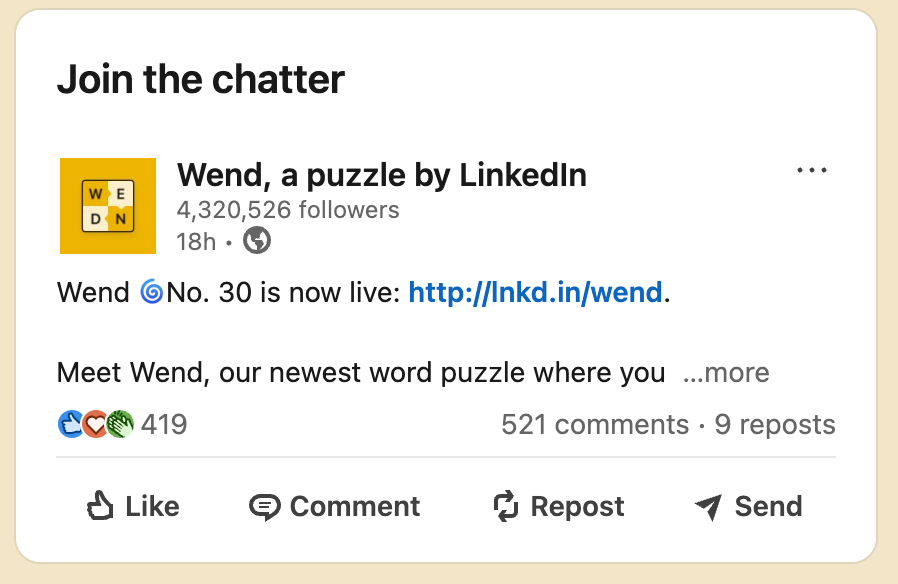
Embed the conversation. The “join the chatter” daily post is currently a link-out at the bottom of the stack — the conversation LinkedIn says it wants to spark is one click away and below the fold. In the redesign it’s a full right-hand column: post, live comments, and a reply box pre-filled with your time (”Share your time — 1:24…”). That pre-fill is the reaction button’s cousin. It removes the “what would I even say” barrier between finishing a puzzle and talking about it. The reveal page stops being a receipt and starts being a room.
There’s an honest tradeoff here: an embedded comment feed competes with the “play another game” cross-sell for attention. LinkedIn’s data team would A/B those against each other — conversation depth vs. games per session — and which one wins would tell you a lot about what they think games are actually for.
The mobile reveal, un-stacked
Mobile can’t do columns, but the current design’s problem isn’t columns — it’s ceremony. Six full-width cards, each treating its content as un-missable, adding up to about four screens of scrolling.
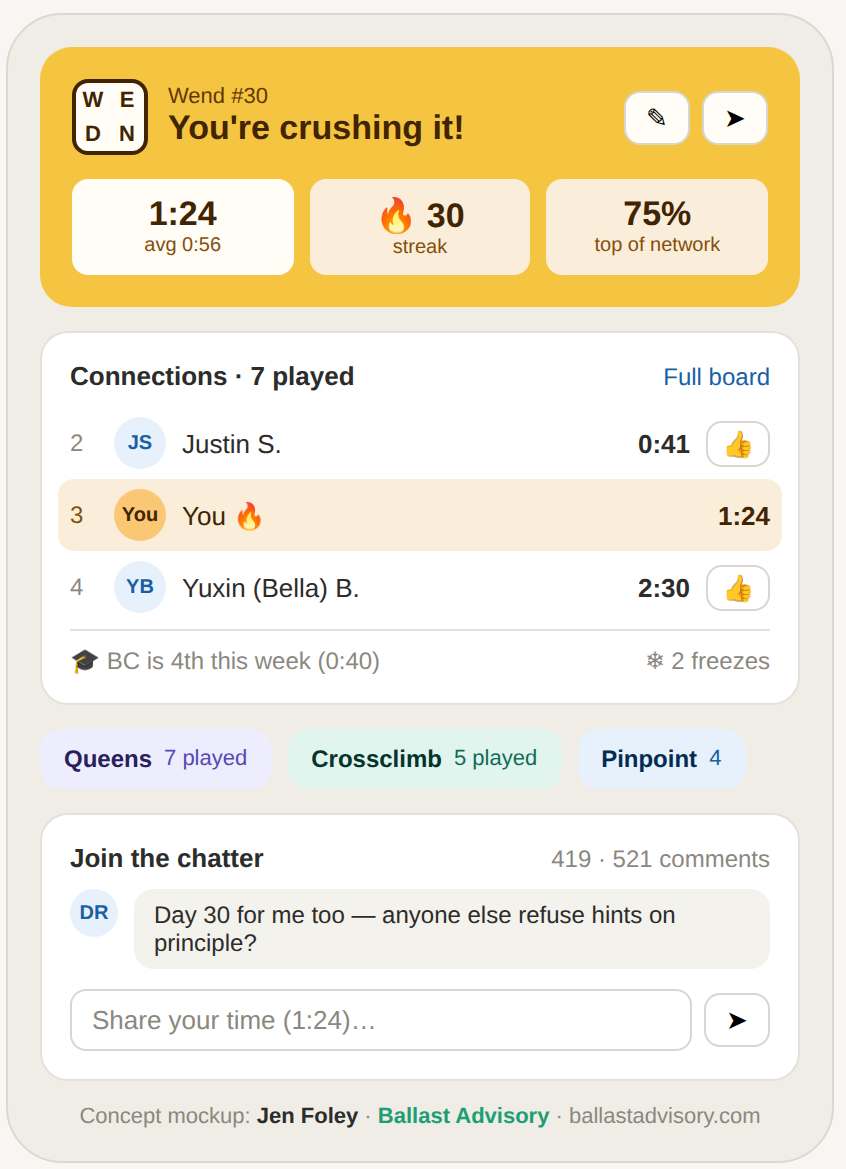
The fix is merging and demoting:
The hero absorbs the carousel — three stats become a chip row, no arrows, no hidden slides.
The connections leaderboard, school ranking, and streak status merge into one social card, with the school rank and streak freezes demoted to a single footer line (”BC is 4th this week · 2 freezes”). That’s the honest hierarchy: the school leaderboard is a fun fact, not a destination.
The game cross-sell becomes a swipeable one-row chip rail — a pattern LinkedIn already uses elsewhere in the app, oddly.
The chatter card shrinks to one comment plus the reply box, so the conversation-starting moment is actually reachable.
Same information, roughly a screen and a half. Because here’s the thing about the current design: six full-width stacked cards is what you ship when every internal team wants their feature to be un-missable. The stack isn’t an information hierarchy — it’s an org chart.
My read: LinkedIn Games is still mid-evolution, the social layer is in flight, and when it ships, the experience transforms from solo to community.
Until then, I’ll be defending my streak, losing to Emily, and doing my small daily part for Boston College’s average. Go Eagles.
Sources: Content Marketing Institute — interview with LinkedIn's games PM · Social Media Today — connection leaderboards launch · Social Media Today — Playback recap · CNBC — Mini Sudoku launch · ConnectSafely — 2026 LinkedIn statistics · Fast Company — NYT Games' 2025 numbers